 blog
blog
Restaurant Loyalty Software vs Manual Punch Cards
Table of Contents
- How Manual Punch Cards and Loyalty Software Actually Compare
- The Real Cost of Restaurant Loyalty Software vs Printing Punch Cards
- Customer Data, Analytics, and Fraud Prevention in Digital Programs
- Restaurant Customer Retention Strategies That Work With Either System
- How to Track Customer Loyalty Metrics That Predict Repeat Visits
- Implementation Friction, Staff Training, and the Hybrid Loyalty Model
- Frequently Asked Questions
Last Updated: September 11, 2026
How Manual Punch Cards and Loyalty Software Actually Compare
The restaurant loyalty software vs manual punch cards debate usually gets framed as old versus new, but that framing misses the real question. The choice comes down to what you can measure, what you can prevent, and what your staff can actually execute during a Friday dinner rush. This guide from The Regulars Club breaks down where each system wins, where each one fails, and how to decide without wasting money on either.
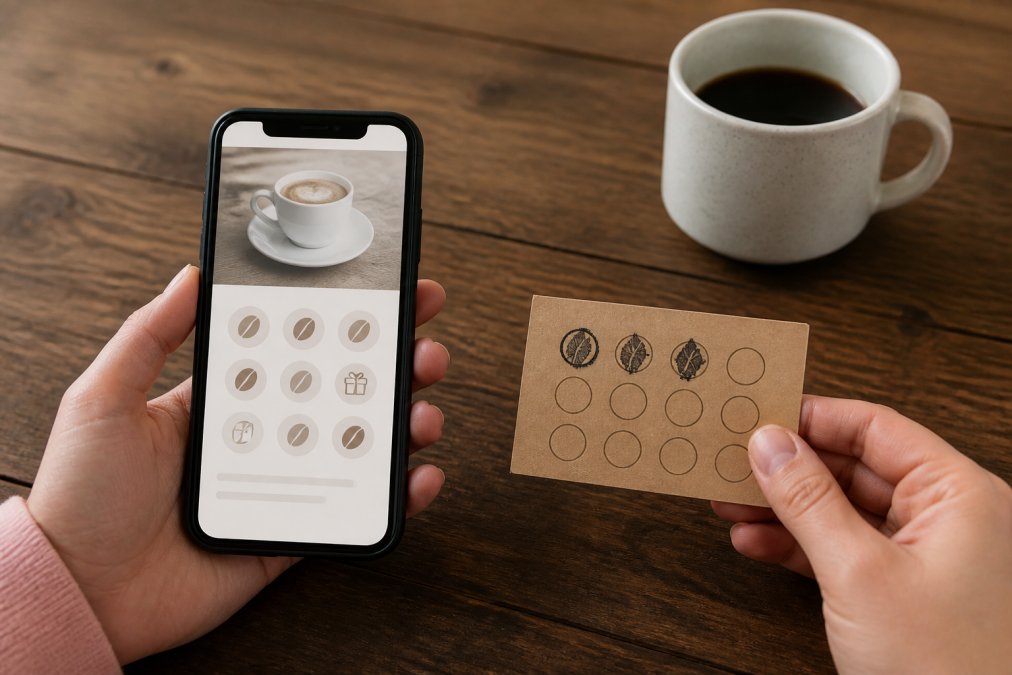
A physical punch card is a paper card a restaurant stamps or punches each time a customer visits, with a free item or discount unlocked after a set number of visits. It requires no hardware, no subscription, and no training. That simplicity is its entire value proposition, and it is also its ceiling.
Where Punch Cards Still Win
Punch cards win on friction and upfront cost. A box of printed cards costs a few dollars, staff hand one over at checkout, and nobody needs to learn a new system. For a new cafe with thin margins and no marketing budget, that matters.
They also work when your customer base is small and local. If the same forty people walk in every week, a punch card builds familiarity. Regulars like the ritual of a physical card, and there is no app to download or account to create.
The problems show up later. Cards get lost, forgotten at home, or thrown out with the receipt. Staff forget to punch them during a rush. And you have no idea who is using them, how often, or whether the program is changing behavior at all.
Where Loyalty Software Pulls Ahead
Loyalty software tracks every visit, purchase, and redemption in a customer database, then uses that record to trigger rewards, personalized offers, and automated messaging. That record is the difference between guessing and knowing.
Digital programs also solve the fraud problem punch cards cannot. Paper gets duplicated, pre-punched, or shared between friends. A digital system ties rewards to a phone number, account, or QR code, so redemption is verified in real time.
The trade-off is real: software adds a monthly cost, a setup process, and a change in staff workflow. That friction is exactly why so many independent operators stall halfway through a switch.
The Real Cost of Restaurant Loyalty Software vs Printing Punch Cards
The cost of restaurant loyalty software is not just the subscription fee. It is the subscription plus setup time plus staff training plus the POS integration work, offset by the revenue a working program recovers. Printing punch cards looks cheaper because the expense is visible and one-time. That visibility is deceptive, and it is why so many operators pick paper and then wonder why repeat visits never move.
To compare honestly, put both systems on the same ledger. A manual program carries a print run, reprints whenever the design or reward changes, the staff seconds spent punching at checkout, and the margin lost to duplicated or pre-punched cards. A software program carries onboarding time, a recurring subscription, the hours to connect it to your point of sale, and the staff seconds spent scanning. The two columns look nothing alike until you normalize them to the same unit: cost per redeemed reward.
| Cost line | Manual Punch Cards | Loyalty Software |
|---|---|---|
| Upfront | Print run for the first batch | Onboarding and setup time |
| Ongoing | Reprints as cards run out or change | Recurring subscription |
| Staff time per visit | Manual punch or stamp | Scan or lookup |
| Integration | None | Point-of-sale connection work |
| Fraud exposure | High, easy to duplicate | Low, verified redemption |
| Customer data captured | None | Full transaction history |
| Cost per redeemed reward | Rises when cards are lost | Falls as redemption rate climbs |
A punch card program where most cards are lost before redemption has a high true cost per reward, because you paid to print cards that never converted. A software program with a modest recurring fee and strong redemption rates often costs less per reward delivered, because the same subscription covers every member who redeems.
A Break-Even Framework You Can Run Yourself
You do not need a finance team to decide. You need four numbers and a quarter of patience.
- Baseline visits. Record average visits per customer per year before the program starts.
- Incremental visits. Measure the increase in visits among enrolled customers after launch.
- Revenue lift. Multiply incremental visits by average spend per visit.
- Program cost. Add the subscription, setup time valued at your labor rate, and staff hours.
- Net return. Subtract cost from revenue lift. Positive means the program pays for itself; negative means you are subsidizing a habit.
The break-even point is the month where cumulative revenue lift overtakes cumulative program cost. A program with a reachable reward and consistent staff compliance can cross that line within the first few months, while a program nobody mentions at checkout may not. Run the math quarterly, not once, because a program that breaks even in month two can drift into a loss if redemption quietly stalls.
Customer Data, Analytics, and Fraud Prevention in Digital Programs
Data analytics is the strongest argument for going digital, and it is the one operators underuse most. Every transaction in a loyalty system adds to a customer database that shows visit frequency, average spend, and which offers actually drive return trips.
With that record, you can segment customers and send personalized offers to the people most likely to respond. Marketing automation handles the timing: a message to someone who has not visited in three weeks, a birthday reward, a nudge after a first visit that never turned into a second.
Fraud prevention comes free with the same infrastructure. Real-time tracking flags duplicate accounts, suspicious redemption patterns, and shared codes. Paper cannot do any of this, which is why punch card programs quietly leak margin.
FTC guidance on customer data and advertising practices is worth reading before you collect anything, because how you store and use customer information carries legal obligations regardless of how small your program is.
An important limitation: software only helps if you act on the data. A dashboard nobody opens is just a more expensive punch card.
Restaurant Customer Retention Strategies That Work With Either System
Restaurant customer retention strategies share one principle: make the next visit easier to justify than the last. The mechanism matters less than the consistency.
With punch cards, that means keeping the reward threshold reachable. A card that needs twelve visits to earn a small discount will lose most customers before they finish (hbr.org). A card that needs five will convert far more often.
With software, the same logic applies but you have more levers: reward tiers, time-limited offers, and automated messaging that brings people back before they forget you. Restaurants that combine a clear incentive structure with consistent follow-up see stronger repeat visit frequency than those relying on the reward alone. A dedicated Restaurant Customer Loyalty Program is built around exactly this kind of structured follow-up, giving operators a ready-made framework instead of assembling one from scratch.
Here is a simple retention checklist that works with either system:
- Set the reward threshold low enough that most customers reach it
- Train every staff member to mention the program at checkout
- Track redemption rate monthly, not annually
- Follow up with lapsed customers before they are gone for good
- Change offers seasonally so the program does not feel stale
How to Track Customer Loyalty Metrics That Predict Repeat Visits
Knowing how to track customer loyalty metrics separates operators who improve from operators who hope. The core metrics are repeat visit frequency, redemption rate, average spend per visit, and churn.
Repeat visit frequency tells you whether customers come back on a predictable rhythm. Redemption rate shows whether the program is actually being used. Average spend per visit reveals whether loyalty members spend more than non-members, which is the clearest signal a program is working. Churn reduction, measured as the share of customers who stop visiting within a set window, tells you whether you are losing people faster than you acquire them.
Customer lifetime value ties it together. A regular who visits weekly for a year is worth far more than a one-time diner, and the whole point of a loyalty program is to shift people from the second group into the first.
A practical ROI calculation framework for any loyalty program:
- Baseline: Record average visits per customer per year before the program.
- Incremental visits: Measure the increase in visits among enrolled customers.
- Revenue lift: Multiply incremental visits by average spend per visit.
- Program cost: Add subscription fees, setup time, and staff hours.
- Net return: Subtract cost from revenue lift. If the result is positive, the program pays for itself.
This framework works whether you are counting punch cards or subscription fees. Run it quarterly, not once.
Implementation Friction, Staff Training, and the Hybrid Loyalty Model
Implementation friction is where most loyalty programs die, and almost no guide addresses it honestly. The failure is rarely the software. It is the counter. A system that adds three steps to checkout will get skipped during a rush, no matter how good the software is. The fix is to reduce the number of decisions staff make. If the loyalty action is one scan or one button, compliance stays high. If it requires looking up an account, confirming a reward, and applying a discount manually, it will fail on busy nights.
Training That Survives a Friday Rush
Staff training fails when it is delivered once, in a meeting, and never reinforced. A pattern that works is to train the loyalty action as a single motion tied to an existing step, not as a separate task. If the card gets punched when the receipt prints, or the account gets scanned when the order is rung, the action rides along with muscle memory instead of competing with it.
- One action, one owner. Decide who performs the loyalty step and never split it between roles.
- Script the ask. Give staff one sentence to say at checkout so the pitch is consistent and fast.
- Rehearse the rush. Practice the loyalty step during a busy shift, not a quiet one.
- Audit weekly. Spot-check redemption logs to catch silent non-compliance before it becomes habit.
A common pattern is that compliance is high in week one, dips in week three as novelty fades, and only holds if a manager is visibly checking. Treat the first month as a launch, not a handoff.
The Hybrid Loyalty Model
A hybrid loyalty model blends both approaches. Customers who prefer paper keep a card; everyone else uses a digital account. The restaurant captures data on the digital side while preserving the low-friction experience paper offers. It is not elegant, but it works during transition periods and for older clientele who resist apps.
The most practical bridge is a QR code printed on the physical card that links to the digital account. A regular who already carries the card can scan it once to enroll, and from then on the same visit is tracked digitally without asking them to change their habit. The card becomes the on-ramp rather than the destination.
A hybrid also lets you phase the rollout by daypart or location instead of flipping the whole restaurant at once. Start the digital side at the register during slower hours, keep paper available everywhere, and let the mix shift as customers self-select. You capture the data you need without forcing a hard cutover that staff will resent.
The Environmental Angle
Environmental impact is the other underdiscussed factor. Printed cards generate ongoing paper waste, and reprints multiply it. Digital programs cut that waste, though they shift the cost to device and server energy, so neither option is perfectly clean. For operators whose brand leans on sustainability, the reduction in printed material is a genuine selling point to customers, not just an internal cost saving.
EPA guidance on waste reduction and paper use outlines how small businesses can cut printed material waste without disrupting operations.
Frequently Asked Questions
Are digital loyalty programs more effective than paper punch cards?
Digital programs generally drive more repeat visits because they track every transaction and can send automated reminders. Paper punch cards depend on customers remembering to bring them, and they offer no data on visit frequency or spending. The tradeoff is simplicity: punch cards require zero setup, while loyalty software needs a short onboarding period. Many restaurants run both for a few months before deciding.
What are the main disadvantages of using manual punch cards for restaurants?
Punch cards are easy to lose, easy to fake, and impossible to analyze. Staff have to remember to punch them during a rush, and there is no way to see which customers are close to earning a reward. They also cap your marketing: you cannot send a personalized offer to someone who has not visited in three weeks because you have no contact information.
How does restaurant loyalty software increase customer retention?
Loyalty software tracks transaction history and visit frequency, which lets you spot customers who are drifting away before they stop coming. Automated messaging can nudge them with a personalized offer. Because rewards are tied to a customer database rather than a piece of cardboard, you can also segment regulars from occasional visitors and treat each group differently.
How do I track customer loyalty metrics without replacing my POS system?
You can track the basics manually: count repeat visits, note average spend per visit, and ask regulars how they heard about you. For anything more precise, look for a loyalty platform that works alongside your existing point of sale rather than replacing it. Many programs let you add discount buttons directly into your current POS so redemption stays simple for staff.
The real challenge is not choosing between paper and software. It is building a program your staff can run consistently and your customers actually notice. The Regulars Club helps independent restaurants turn occasional customers into loyal regulars with a membership platform that works alongside your existing POS, offering member-only perks, monthly rewards, and BOGO deals without a hardware overhaul. Get started with The Regulars Club and turn repeat visits into recurring revenue.