Why Staff Training Drives Repeat Visits and Revenue
Restaurant staff training tips for better customer service start with one uncomfortable truth: most guests don't leave because the food was bad, but because the experience felt forgettable. At The Regulars Club, we work with independent restaurants every day, and the owners who win repeat business treat service as a trained skill, not a personality trait.
Key TakeawayA guest who feels genuinely recognized is far more likely to come back than one who simply got correct service. Recognition is trainable. Correctness is the floor, not the goal.
Restaurant Customer Service Best Practices That Stick
The best customer service practices are the ones staff can repeat under pressure. Instead of training servers on a long list of ideals they forget by week two, build a short service sequence and drill it until it's automatic.
Greeting, Seating, and the First 90 Seconds
The first 90 seconds set the tone for the entire meal, guests decide whether they feel welcome long before the food arrives. Train staff to make eye contact, use a genuine greeting, and acknowledge anyone waiting.
Menu Knowledge and Suggestive Selling
Menu knowledge is the foundation of confident service. A server who can describe a dish, name its ingredients, and suggest a pairing sounds like an expert, and that confidence makes suggestive selling feel like a recommendation instead of a pitch.
Restaurant Server Training Scripts You Can Copy Today
"Welcome in. I'm [name], I'll be taking care of you tonight. Can I start you with something to drink while you look over the menu?"
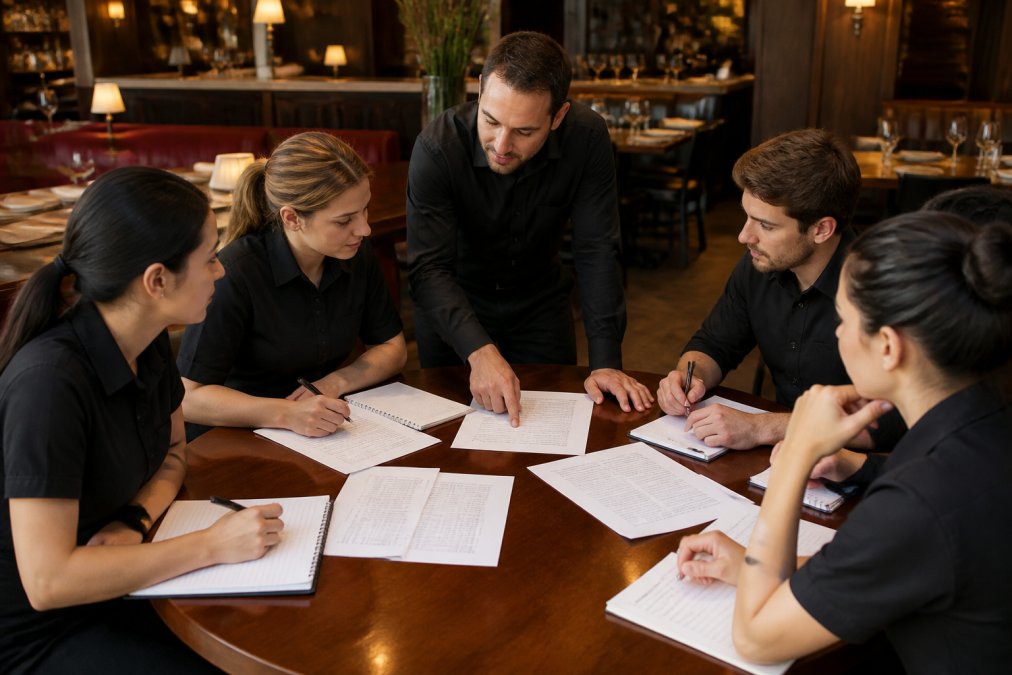
Manager leading a staff training session with servers reviewing printed scripts and notepads at a restaurant table.
And a check-back script:
"How's everything tasting so far? Is there anything I can bring you?"
Scripts for Upselling Without Feeling Pushy
The trick to upselling is timing and framing. Suggest add-ons when the guest is already deciding, not after they've closed the menu. Frame the suggestion around their experience, not your sales target.
"That dish pairs really well with our [side]. Want me to add one?"
"We just made a fresh batch of [dessert]. Want me to save you a slice before it's gone?"
"Would you like to start with an appetizer while the kitchen fires your entrée?"
Pro TipTrain servers to suggest one item, not three. A single confident recommendation converts far better than a list, and it never feels like a sales pitch.
How to Handle Difficult Customers in a Restaurant
Handling difficult customers comes down to one principle: solve the problem before defending yourself. Guests who complain want to be heard and made whole, not to win an argument. Most training stops at the acronym and never teaches staff what to say, when to escalate, or how to close the loop.
Listen without interrupting. Let the guest finish, even if the complaint is wrong on the facts. Brief acknowledgments ("I hear you") keep them talking until the emotional peak passes, most complaints lose their charge within 30 to 60 seconds of uninterrupted venting.
Apologize for the experience, not the fault. "I'm sorry this happened" lands better than "I'm sorry we messed up," because it doesn't force the server to admit fault before the facts are clear.
Solve with a concrete fix. Vague promises ("I'll let the kitchen know") read as dismissal. Specific actions ("I'm bringing you a fresh plate now, and I've taken that item off your check") read as ownership.
Thank them for telling you. "Thank you for saying something, I'd rather fix it now than have you leave unhappy" reframes the complaint as a gift, not an attack.
De-Escalation Mechanics That Actually Work
Tone and body language carry more weight than words when a guest is upset. Train four physical habits:
Lower your volume and slow your speech. Matching an angry guest's volume escalates; dropping yours forces them to lean in and quiet down.
Keep hands visible and open. Crossed arms, hands on hips, or a pen pointed at a guest all read as confrontation.
Step to the side, not back. Backing away signals fear; angling your body slightly and gesturing toward a quieter part of the room moves the conversation without a power struggle.
Use the guest's name once, calmly. It re-humanizes the exchange and pulls the interaction out of pure transaction mode.
Watch OutNever let a server argue about who was right. Winning the argument loses the guest, and a bad review costs far more than the dish in question.
Service Recovery Tiers
Give staff a simple three-tier framework so they don't over-give on small issues or under-give on serious ones.
Tier
Situation
Standard Response
Who Approves
1
Minor delay, wrong side, slow refill
Apologize, fix immediately, no comp
Server
2
Wrong entrée, long wait, cold food
Replace item, comp that item, manager check-in
Server + manager
3
Rude service, illness concern, repeated failure
Full recovery, manager-led conversation, follow-up
Manager / owner
Scripts for Common Difficult Moments
Hand these to new hires on day one, scaffolding, not a cage. Staff should adapt the wording once they're comfortable.
Wrong order delivered: "I'm so sorry, that's not what you ordered. Let me get the right dish started right now, and I'll bring you something to nibble on while you wait."
Long wait for food: "I know the wait has been longer than it should be. I just checked with the kitchen and your order is [X minutes] out. Can I bring you another drink on us while you wait?"
Guest says the food is bad: "Thank you for telling me. Can you tell me what's off about it? I want to make sure the kitchen knows exactly what happened." Then act, replace, comp, or escalate.
Guest is intoxicated and getting loud: "I want to make sure you're taken care of. Let me bring you some water and something to eat, and I'll check back in a few minutes." Involve a manager early; never let a server handle this alone.
Guest demands to speak to the manager: "Absolutely, let me get them for you right now." Never ask why first. The request itself is the signal.
Close the Loop Internally
A complaint handled well at the table is only half the job; the other half is making sure it doesn't repeat. Build a short end-of-shift debrief into your routine, what went wrong, what the fix was, what changes next time, and review the log weekly in your pre-shift huddle so patterns surface. Three complaints about the same dish in one week is a kitchen problem, not a service problem.
Key TakeawayTrain the mechanics, not just the acronym. De-escalation is physical, service recovery is tiered, and every complaint should leave a trace the next shift can act on.
Food Safety and Sanitation Training Basics
Food safety training is non-negotiable and regulated. Every food handler needs the fundamentals: proper handwashing, temperature control, cross-contamination prevention, and safe storage.
Keeping Service Consistent Across Every Shift
Consistency is where most restaurants quietly fail: the Friday-night crew delivers a great experience, the Tuesday-lunch crew an average one, and guests notice. The fix isn't stricter rules, it's a training cadence, a shared standard, and a team that isn't running on empty.
Build a Training Cadence, Not a One-Time Event
Most restaurants train once at onboarding and never again, which is why standards drift. A workable cadence:
Daily (5 minutes): Pre-shift huddle. One service focus for the day (e.g., "today we're nailing the check-back within two minutes of food hitting the table"). One menu item to taste or review.
Weekly (15-20 minutes): Role-play one difficult scenario from the script library. Rotate who plays the guest so everyone practices both sides.
Monthly (45-60 minutes): Full team review. Walk through the service sequence, refresh food safety basics, and recognize staff who nailed a recovery moment.
Quarterly: Re-certify on food safety and re-train any standard that's slipped. Use guest feedback and review mentions to pick the focus.
Standardize the Standard
Write down your service sequence, greet, seat, take the order, check back, close, and put it somewhere every shift can see it. Use a shared digital document, not tribal knowledge passed between veterans. Tools like Operandio and Mitti digitize manuals and checklists so standards don't drift when a key employee leaves.
Measure What Guests Actually Feel
You can't manage consistency you don't measure. Track three simple signals:
Check-back timing. How long after food hits the table does a server check in? Two minutes is a common target.
Complaint frequency and type. Log every complaint by category. Patterns point to training gaps, not bad employees.
Review sentiment. Read your public reviews weekly and tag them by theme, service, speed, food, atmosphere. A rising service theme is your early warning.
Prevent Burnout Before It Hits the Floor
A server running six doubles in a row will not greet anyone warmly. Burnout is a service problem, not just an HR problem, and it shows up in the guest experience before it shows up in turnover.
Concrete practices that help:
Cap consecutive doubles. Two in a row is a common ceiling; three is where warmth starts to fade.
Rotate stations. Same section every shift breeds autopilot. Rotating high-volume and low-volume sections keeps attention sharp.
Protect breaks. A real 15-minute break off the floor, not a break spent rolling silverware.
Check in weekly, briefly. A two-minute one-on-one with each server catches problems before they become complaints.
Cross-train. Staff who can work multiple roles feel more capable and less trapped, and you get scheduling flexibility when someone calls out.
Pro TipWatch the last hour of a double shift. That's where service quality drops most, and where a five-minute breather for a server pays for itself in one saved table.
A Simple Consistency Tracker
Problem
Fix
Impact
New hires improvise service
Shared script library + day-one walkthrough
Consistent guest experience
Standards drift over time
Digital checklists + weekly role-play
Fewer service gaps
Feedback never reaches staff
Weekly huddle reviews + tagged review themes
Faster improvement
Burnout lowers effort
Cap doubles, rotate stations, protect breaks
Better staff retention
One shift outperforms another
Measure check-back timing and share results
Even experience across shifts
Key TakeawayConsistent service isn't about stricter rules. It's about giving every shift the same tools, the same scripts, the same measurements, and the same support, so the guest experience doesn't depend on who happens to be working.
Training is what earns a guest's first good impression, but retention is what turns that impression into repeat visits. A Restaurant Customer Loyalty Program gives your team a structured way to recognize regulars and reward them for coming back, while a Restaurant Membership Program builds the kind of recurring revenue that makes consistent service investment worthwhile.
Frequently Asked Questions
What are some good training ideas for restaurant staff?
Start with short, hands-on sessions instead of long lectures. Pair a new hire with a seasoned server for their first three shifts, run five-minute pre-shift huddles on one topic like wine pairings or allergen handling, and use role-play to practice difficult scenarios. Add a simple checklist for opening and closing duties so nothing gets missed. Rotating topics keep staff engaged and build confidence faster than a single onboarding day.
How can staff training directly impact restaurant loyalty?
Guests return to places where they feel recognized and well cared for. Training that covers active listening, menu knowledge, and service recovery gives staff the tools to turn a good meal into a memorable one. When servers remember a regular's usual order or fix a mistake quickly, that guest is far more likely to come back. Consistent service standards also make it easier to introduce a membership or loyalty program that rewards repeat visits.
What are the most important soft skills for restaurant servers?
Active listening tops the list, since it prevents order errors and helps servers read a table's mood. Emotional regulation matters too, especially when a guest is upset. Add teamwork, clear verbal communication, and body language awareness. Servers who can stay calm, make eye contact, and adjust their tone handle rush periods and complaints far better. These skills can be practiced through role-play and feedback, not just taught once.
How do you handle difficult customers in a restaurant without escalating the situation?
Listen fully before responding, apologize for the experience without assigning blame, and offer a concrete fix such as remaking the dish or adjusting the bill. Keep your voice low and steady, and avoid arguing in front of other guests. If the situation continues, bring in a manager. Afterward, log what happened so the team can spot patterns. Training staff on these steps ahead of time keeps small problems from becoming public scenes.
 ultimate-guide