 How-to
How Do You Create Exclusive Member Events for Restaurant Regulars?
Last Updated: November 13, 2026
Quick Summary
Create member events by first building a defined regulars segment from your POS and email data, then choosing a format that fits your kitchen, such as a chef's table or tasting night. Run a break-even model before each event, and promote it with short personal invitations sent one to two weeks ahead.
- Pull a six-month export from your POS and email platform and rank guests on visit count, spend, and recency.
- Publish two or three tiered invitation criteria so guests can see how to qualify.
- Separate fixed costs from per-guest costs, then divide fixed costs by price minus per-guest cost to find break-even seats.
- Stress-test event economics at 60% attendance, since no-shows are the biggest threat to profit.
- Measure seats filled, revenue per guest, and return visits within 30 days after each event.
Table of Contents
- Why Member-Only Events Keep Regulars Coming Back
- Step 1: Choose Your Member Segment and Invitation Criteria
- Step 2: Pick a Food Theme Night Format That Fits Your Kitchen
- Step 3: Plan Event Economics and Break-Even Numbers
- Step 4: Run Operations and Service Execution on the Night
- Step 5: Promote Member Events With Ready-to-Use Invitations
- Measuring Event Performance and Planning Your Next Member Night
- Booking Your First Regulars-Only Dinner Event
- Frequently Asked Questions
Why Member-Only Events Keep Regulars Coming Back
Your best customers are not always your newest ones. A small group of frequent diners can drive a large share of your business, and member-only events are one of the simplest ways to keep them coming back. The Regulars Club helps restaurant owners turn occasional guests into loyal regulars by giving them a reason to feel special.
Toast data from Q1 2026 suggests that up to 50% of restaurant order volume can come from just 7% of guests (Toast, The Regulars Report 2026). That is a strong argument for treating regulars as a priority, not an afterthought.
Exclusive events give those guests something they cannot get by walking in off the street. A SevenRooms report for 2026 found that 74% of consumers plan to or have already returned to a restaurant after a unique experience (SevenRooms, 2026 U.S. Restaurant Trends Report). A VIP Dining Membership program is one way to formalize that insider status so it feels earned and recurring.
- Events make regulars feel recognized
- Invitations create a reason to come back
- Limited seats build demand before the night
Keep the event small and specific. A themed dinner for 30 people often does more for loyalty than a crowded open-house night.
Step 1: Choose Your Member Segment and Invitation Criteria
Start by deciding who gets invited. Not every guest needs to be in the first group, and a clear rule keeps the list fair and easy to explain. The mistake most operators make is treating "regular" as a feeling instead of a definition, which means the list changes every event and guests can never tell whether they qualify.
Build the segment from data you already have. Pull a six-month export from your point-of-sale system and your email or text platform, then sort guests on three fields: visit count, total spend, and recency (days since last visit). A common pattern is to score each guest on all three and rank the list, rather than gating on a single threshold. That surfaces the guest who visits often but spends modestly alongside the guest who visits rarely but spends heavily, both are regulars, and both belong in different events.
Set tiered, published criteria. Two or three tiers work better than one list because they give guests a ladder to climb:
- Inner circle: 8 or more visits in six months, or top 10% of spend
- Core regulars: 4 to 7 visits in six months
- Rising guests: 2 to 3 visits, plus email or text opt-in
Publish the criteria on your website and in your member emails. Transparent rules make exclusivity feel earned rather than arbitrary, and they head off the awkward "why wasn't I invited?" conversation before it starts.
Match the event to the segment. A chef's table for 12 suits the inner circle; a cooking class for 24 suits core regulars; a first-look tasting suits rising guests you want to convert. A structured Restaurant Customer Loyalty Program can handle this tiering automatically as guests move between levels.
Handle the edge cases in writing. Decide in advance how you treat guests who opt out of marketing, guests who only order takeout, and guests whose visits are split across multiple people on one check. Write the answers down so every host and manager applies the same rule.
Watch out: if your POS and your email platform don't share a guest identifier, your list will double-count some guests and miss others, reconcile the two exports by phone number or email before you build tiers.
Tools that track guest preferences, like the approach in How to Use Guest Preferences for Targeted Restaurant Promotions, can help you build this list without guesswork.
Step 2: Pick a Food Theme Night Format That Fits Your Kitchen
Your event should match what your kitchen can handle well. A tasting menu for 40 guests is a bad idea if your line cooks are already stretched on Friday nights.
Choose a format based on your space and staffing:
- Chef's table: 12 to 16 seats, one course at a time, lots of interaction
- Tasting night: a set menu with wine or beer pairings
- Cooking class: guests make one dish with your chef
- Special menu night: one dessert or dish available only to members
Pick one format and keep it consistent. Regulars come back for the next event when they know what to expect. For more ideas on the kinds of events that work, see Personalized Dining for Members: A Step-by-Step Guide.
Step 3: Plan Event Economics and Break-Even Numbers
Member events cost money, so plan the numbers before you send invitations. That same break-even discipline can shape luxury brand event activation, helping you weigh the cost of each detail against the seats you need to fill.
Separate fixed costs from per-guest costs. Fixed costs don't change with headcount: staff hours for setup and service, décor, music or entertainment, printed menus, and any rented equipment. Per-guest costs scale with every seat: food cost, beverage cost, and any take-home gift.
Worked example (illustrative numbers, substitute your own):
- Fixed costs: 40 staff hours at your loaded hourly rate, plus décor, music, and printing
- Per-guest food and beverage cost: your plate cost for the set menu, times the number of courses
- Capacity: the number of seats your room and kitchen can genuinely serve at event pace
Break-even seats = fixed costs ÷ (price per seat − per-guest cost). If fixed costs are $1,200, the ticket is $85, and per-guest cost is $32, you need about 23 seats to break even.
Decide what "profit" means for this event. A member night can pay for itself three ways: ticket revenue, incremental spend on the night (cocktails, retail, extra courses), and return visits in the following 30 days. Many operators price the ticket to cover food and labor and treat the follow-on visits as the real return. That is a legitimate strategy, but only if you actually measure the follow-on visits, which is why the tracking in the measurement section matters. Ongoing Recurring Revenue for Restaurants models are built on exactly this kind of repeat-visit tracking.
Stress-test the downside. Run the model at 60% attendance, not just at a full room. If the event loses money at 60% capacity, either raise the ticket, cut a fixed cost, or shrink the room.
Price against the experience, not the plate. Members compare the ticket to a normal night out, not to your food cost.
Watch out: don't fold complimentary welcome drinks or desserts into "marketing", they are per-guest costs and belong in the variable column, or your break-even seat count will be too low.
Track results after each event so you can adjust next time. The operators who run this model before every event are the ones who can afford to keep running them.
The break-even model below uses the article's own worked example, with each figure stated in the text.
| Cost or figure | Value | Note |
|---|---|---|
| Fixed costs | $1,200 | Staff hours, décor, music, printing |
| Ticket price | $85 | Price per seat |
| Per-guest cost | $32 | Food and beverage per seat |
| Break-even seats | About 23 | Fixed costs ÷ (price − per-guest cost) |
| Room capacity | 30 | Seats available in the example |
Break-even model inputs for a member event
Step 4: Run Operations and Service Execution on the Night
The night itself decides whether guests feel valued. Plan the flow before the doors open.
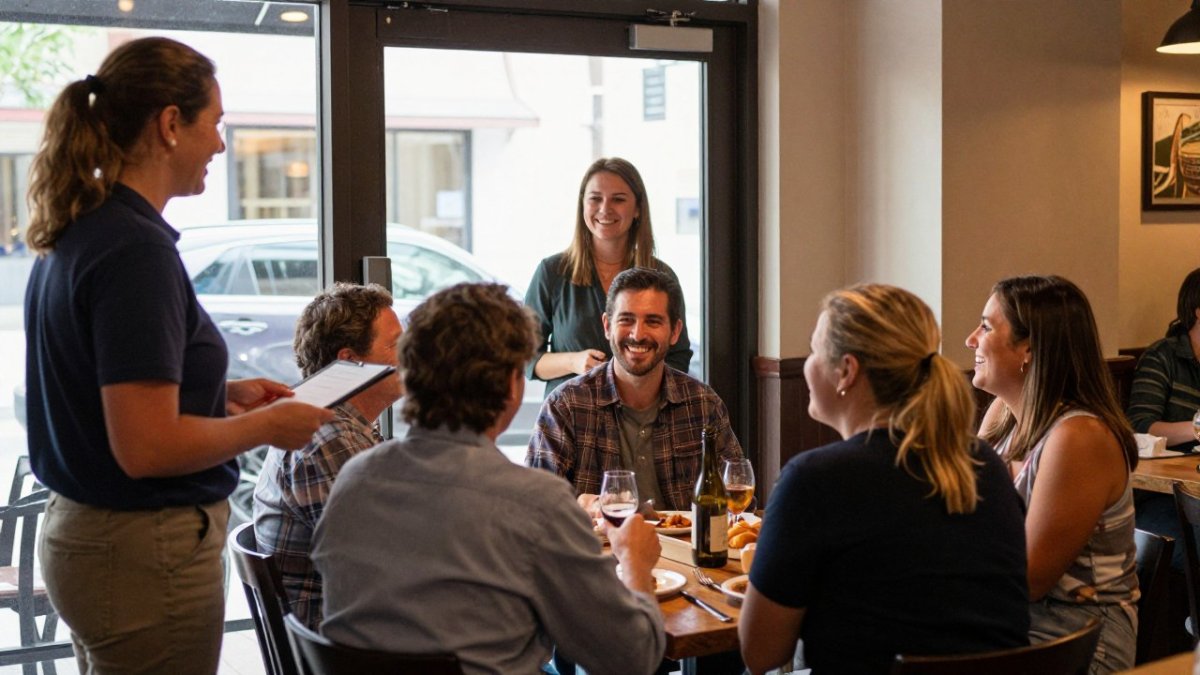
- Assign one host to greet members at the door
- Keep a printed guest list with notes on preferences
- Brief servers on the menu, pairings, and any allergies
- Set the pace so courses arrive on a steady schedule
A server greeting a small group of smiling regular diners at the entrance of a warmly lit restaurant during an evening event. Personal greetings like this make members feel known.
Ask one question during the evening: "How is everything tasting?" Guests remember when staff notice them.
Step 5: Promote Member Events With Ready-to-Use Invitations
Invitations should feel personal and exclusive. Send them by email or text, and keep the wording short.
Here is a template you can adapt:
Hi [First Name], you are invited to our members-only [Theme] night on [Date] at [Time]. Only 24 seats are available, and as a regular, you get first access. Reply YES by [Deadline] to save your seat.
Send the first invitation one to two weeks ahead. Send a reminder three days before. Once the event is full, say so. Scarcity works when it is real.
For campaign timing and automation ideas, read 5 Best Practices for Restaurant VIP Dining Clubs and How to Automate Restaurant Email Campaigns That Fill Tables.
Measuring Event Performance and Planning Your Next Member Night
A member event is only worth repeating if it works. Measure a few simple numbers after every event:
- Seats filled and no-show rate
- Revenue per guest compared with a normal night
- Return visits in the 30 days after the event
- Guest comments and survey responses
Compare the results to your break-even number. If guests came back within a month, the event built loyalty, even if the margin was thin.
Use what you learn to plan the next event. Change one thing at a time so you know what made the difference. Restaurants that want this measurement built in often look at Restaurant Marketing & Customer Retention support to track repeat visits across events.
Booking Your First Regulars-Only Dinner Event
Your first event does not need to be perfect. Pick one segment, one format, and one date. Keep the guest list small, the menu focused, and the invitation simple.
Start with the regulars who already know your restaurant best. Ask them what they would enjoy, then build the night around their answers. Members who help shape an event tend to show up for the next one.
Ready to build a loyal regulars group for your restaurant? The Regulars Club helps independent restaurants turn occasional guests into repeat customers, and you can register your restaurant to get started.
Frequently Asked Questions
What makes a restaurant event feel exclusive to members?
An event feels exclusive when attendance is limited, invitations are personal, and members get something they cannot get on a regular night, such as a special menu, a chef's table seating, or early access to a new dish. Recognition matters too. Greeting members by name and noting their usual order signals that the evening was planned for them. Keep the guest list small enough that the kitchen and front-of-house can give each table real attention, and say clearly in the invitation who qualifies and why.
How often should a restaurant host member events?
Many restaurants find that one member event each month is enough to keep regulars engaged without wearing out the guest list or the kitchen. Quarterly events can work for smaller venues or for premium formats such as tasting dinners. Pick a schedule you can staff consistently, and tell members the cadence up front so they know when to expect the next invitation. Consistency tends to matter more than frequency.
How can restaurants promote member-only events?
Send personal invitations by email or text to members who have visited recently, and ask servers to mention upcoming events during regular visits. Post a single clear announcement on your website and social channels, but keep the core message for members. Include the date, what is included, how many seats are available, and how to RSVP. Follow up once with a short reminder a few days before the event.
How do you measure whether a restaurant event was successful?
Compare attendance against seats offered, track revenue per guest against a typical night, and count how many attendees return within the following 60 days. Ask attendees a short follow-up question about whether they would come to another event. Calculate whether revenue covered food cost, staffing, and promotion. A successful event is one that covers its costs and brings back a meaningful share of attendees, not one that simply sells out.