 blog
7 Things to Check Before Choosing Restaurant Loyalty Software
Last Updated: November 9, 2026
Quick Summary
Choose loyalty software by first defining how guests earn rewards, then verifying POS integration with a live redemption on your exact POS model. Score vendors on a weighted scorecard covering integration, reward flexibility, reporting, total cost, staff ease of use, and migration support.
- Pick your earning model first: points, digital stamps, tiers, or membership access.
- Ask vendors to show a live redemption on your exact POS model before signing.
- Weight POS integration at 25% and reward flexibility at 20% in your scorecard.
- Build a three-year total cost of ownership model covering setup, recurring, transaction, and exit costs.
- Pilot with a small guest segment and measure results before committing to a contract.
Table of Contents
- Start With How Your Guests Actually Earn Rewards
- Restaurant Loyalty Software Features That Decide the Purchase
- POS Integration: The Check That Kills Most Deals
- How to Compare Restaurant Loyalty Programs Side by Side
- Restaurant Loyalty Program Examples Worth Studying
- Restaurant Loyalty Program Best Practices Before You Sign
- Set Up Your First Membership Offer With The Regulars Club
- Frequently Asked Questions
Start With How Your Guests Actually Earn Rewards
Before you compare a single vendor, answer one question: how does a guest earn a reward in your restaurant? The answer shapes every feature decision that follows. Most operators skip this step and end up buying loyalty software built for a model their guests never use.
A pizzeria may buy a points-based platform because it looked impressive in a demo, then discover its regulars want a simple free-item offer, not a bankable points ledger. Engagement can stall, and the software gets blamed.
The four earning models you will encounter:
- Points-based rewards: guests accumulate points per dollar and redeem later
- Digital stamp cards: buy nine, get the tenth free
- Tiered rewards: spend more, unlock better perks
- Membership access: a flat membership unlocks member-only offers
Pick the model first. Then the software decision becomes a filtering exercise, not a guessing game.
Restaurant Loyalty Software Features That Decide the Purchase
The features that often decide the purchase are reward flexibility, guest data capture, and reporting.
A common mistake is falling for a long feature list. Focus on what moves repeat visits.
Reward redemption rules matter more than reward creation. Can you set expiration dates? Cap redemptions per visit? Exclude alcohol? If the platform forces a rigid structure, your staff will fight it every shift.
Customer data and actionable analytics separate serious platforms from toys. You need guest profiles, purchase frequency, and redemption rate in one dashboard. Data exports matter too, because you should never be locked in.
Personalization and targeted promotions drive the incremental revenue. Bonus offers aimed at lapsed guests beat blanket discounts every time.
If you are weighing a switch from paper, this comparison of restaurant loyalty software vs manual punch cards covers what changes operationally.
POS Integration: The Check That Kills Most Deals
POS integration is often the check that decides whether a deal works, and it deserves close scrutiny. If the loyalty platform cannot talk to your point-of-sale system, staff will redeem rewards manually, mistakes will pile up, and the program quietly dies.
Here is the practical test. Ask the vendor to show a live redemption on your exact POS model, not a generic demo environment.
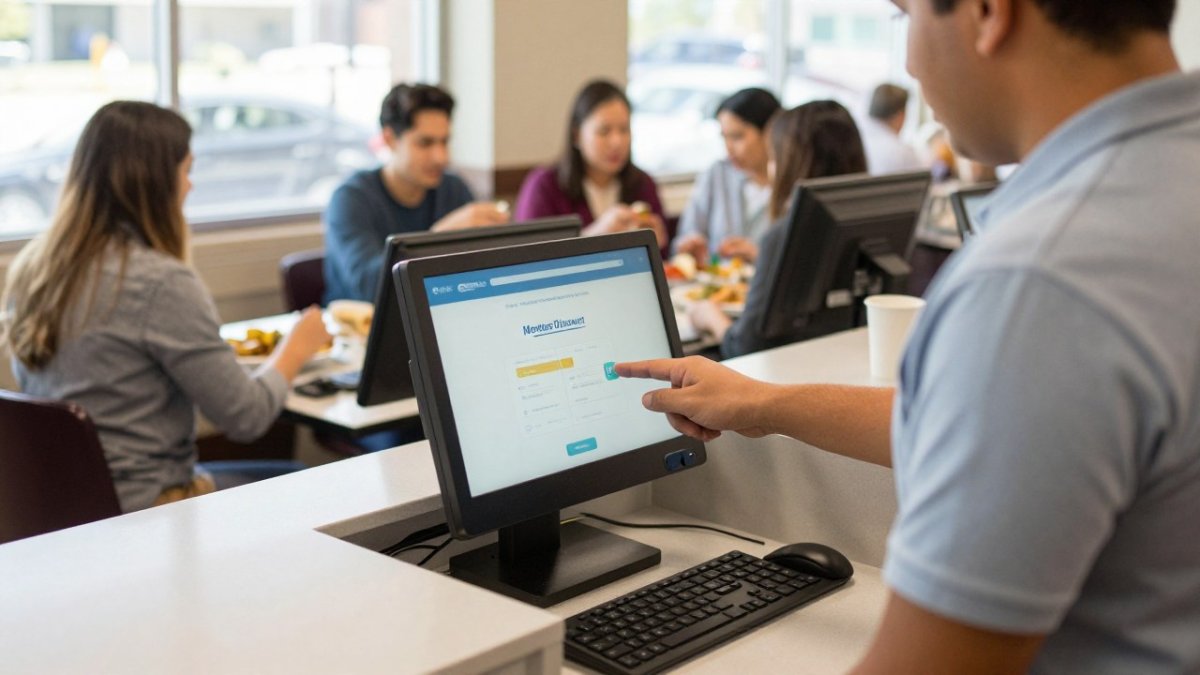
The integration question extends beyond the register. Online ordering, mobile ordering, kiosk ordering, and delivery channels all need to feed the same guest profile. Otherwise your omnichannel experience fractures and your data lies.
For a deeper walkthrough, see this guide to integrating digital loyalty programs with cafe POS systems.
How to Compare Restaurant Loyalty Programs Side by Side
Comparing restaurant loyalty programs side by side requires a weighted scorecard, not a gut feeling. Score each vendor from 1 to 5 on the criteria that matter to your operation, then multiply by a weight. The weights below are a starting point; adjust them to your model. A quick-service operator with high transaction volume should push POS integration and staff speed higher, while a full-service operator with a large regular base may weight reporting and personalization more heavily.
| Criterion | Weight | What to Score |
|---|---|---|
| POS integration | 25% | Live redemption on your exact POS model, receipt accuracy, offline behavior |
| Reward flexibility | 20% | Expiration, caps, exclusions, stacking rules |
| Reporting and data exports | 15% | Guest profiles, redemption rate, scheduled exports, data ownership |
| Total cost of ownership | 15% | Setup, monthly fees, transaction costs, contract terms, exit costs |
| Staff ease of use | 15% | Training time, steps per redemption, error recovery |
| Migration support | 10% | Data import, member balance transfer, launch timeline |
Weight
Add the weighted scores and compare totals. This keeps a slick demo from outvoting a weak integration. A common pattern is for two vendors to land within a few points of each other, which is your signal to go back to the two or three criteria you weighted highest and test them live rather than re-scoring the whole matrix.
Questions to Ask Every Vendor Before You Sign
The scorecard narrows the field; the vendor conversation decides it. Ask these questions in writing and keep the answers, because they become your contract checklist:
- Can you show a live redemption on our exact POS model, in our test environment, before we sign?
- What happens to a redemption if the internet drops mid-service? Does the platform queue it or fail it?
- Who owns the guest data, and can we export the full member list and transaction history on demand?
- What are the setup fee, monthly fee, per-transaction fee, and any per-location or per-member charges?
- What is the contract length, the renewal terms, and the cancellation window?
- What happens to member point balances and stored value if we leave the platform?
- What is the implementation timeline, and who on your team owns the launch?
- Which POS versions and ordering channels are supported today, and which are on the roadmap?
Watch out: a vendor that answers "yes" to integration but cannot name your POS version or show a live redemption is describing a roadmap, not a product. Get the demo on your hardware before the contract, not after.
Total Cost of Ownership and Contract Terms
Pricing pages rarely tell the whole story. Build a three-year total cost of ownership model before you compare vendors, and put every line in the same units so the comparison is honest:
- One-time costs: setup, data import, hardware or peripheral changes, staff training time
- Recurring costs: monthly platform fee, per-location fees, per-member or per-active-member fees
- Transaction costs: any per-redemption or per-transaction charge, and whether it applies to every visit or only redeemed rewards
- Contract terms: length, auto-renewal, price escalation at renewal, cancellation window, and early-termination terms
- Exit costs: data export fees, notice period, and whether member balances transfer
A platform with a lower monthly fee but a per-redemption charge can cost more at high volume than a flat-fee platform. Run the model at your current visit volume and at a realistic growth scenario, because the ranking can flip between the two.
Data portability and privacy belong in the same conversation. Ask for a sample export file, confirm the format is usable outside the platform, and check how consent and retention are handled. If you cannot get your guest data out in a usable form, you do not control it.
To build the financial case, use this framework to calculate restaurant loyalty software ROI before you sign.
Restaurant Loyalty Program Examples Worth Studying
The most instructive restaurant loyalty program examples come from operators who matched the program to their size and service model, not from chains copying a template. Use the matrix below to narrow the field before you study any single example.
Fit by Restaurant Size and Operating Model
| Operating model | Best-fit program structure | What to prioritize in software | Common failure mode |
|---|---|---|---|
| Single location, full service | Digital stamp card or simple points | Fast redemption at the table, staff ease of use | Overbuilding tiers the staff cannot explain |
| Single location, quick service | Points per dollar or punch card | Speed at the counter, offline redemption | Redemption that slows the line at peak |
| Multi-location, same brand | Shared points across locations | Cross-location guest profiles, location-level reporting | Guest profiles that do not merge across stores |
| Franchise | Tiered rewards with brand-set rules | Brand controls plus per-location reporting | Franchisees overriding reward rules |
| High-volume delivery and online ordering | Points tied to the guest profile, not the channel | Omnichannel profile matching | Channel data that never reaches the loyalty profile |
A neighborhood café running a digital stamp card can see regulars return on a predictable rhythm, because the reward is obvious and the redemption can be quick. The mechanic matters: a buy-nine-get-one-free card works because the guest can see progress after every visit, and the staff can redeem it in one step at the register.
A multi-location operator running shared points across stores gets the most value from cross-location reporting: which location drives redemptions, which reward costs the most, and which guest segment lapses after a first redemption.
What these programs share: one clear earning rule, one visible reward, and a redemption path that fits the existing staff workflow. Complexity is where small programs fail. The matrix above is a filter, not a verdict; score the two or three structures that fit your model against the weighted criteria in the comparison section before you commit.
For concrete models sized to independent operators, browse these loyalty programs for small restaurants.
Restaurant Loyalty Program Best Practices Before You Sign
Sound restaurant loyalty program best practices come down to piloting before you commit. Launch to a small guest segment, measure for a defined period, then expand only if the numbers hold.
A few habits that separate programs that last from programs that fade:
- Train every shift, not just managers, on redemption steps
- Set expiration dates that feel fair, not punishing
- Review redemption rate and retention rate monthly
- Keep one owner accountable for the program
- Export your guest data on a schedule you control
Watch out: signing a long contract before a pilot can be a costly mistake. You will not know whether staff workflows hold up until a real busy service tests them.
Set Up Your First Membership Offer With The Regulars Club
The fastest path from research to a working program is a membership offer your guests understand immediately. The Regulars Club connects local restaurants with diners through member-only perks, discounts, free food offers, BOGO deals, and monthly rewards, and members redeem by showing an active membership.
For owners, The Regulars Club lets you add Regulars Club discounts directly into your existing POS as coupon buttons, so you keep your current system. Restaurants create their own offers, so you control the terms, and the platform supports recurring revenue without replacing your POS.
If you want to explore the membership side before committing, you can explore The Regulars Club membership and see how the offers work for diners.
Choosing loyalty software is really a decision about guest experience and staff workflow, and the operators who get it right start with how guests earn rewards, verify POS integration live, and score vendors against a weighted checklist.
Frequently Asked Questions
What should restaurants look for in loyalty software?
Start with four things: a POS integration that applies rewards without staff work, reward rules guests understand in one sentence, reporting that shows repeat visits and redemption rate, and a contract you can exit without losing guest data. Industry research suggests many operators see loyalty programs as important for keeping repeat guests, so the software has to fit your existing service flow rather than add steps to it.
What is the difference between points-based and visit-based restaurant rewards?
Points-based rewards let guests bank value across visits and spend it flexibly, which suits higher check averages and mixed order types. Visit-based rewards, including digital stamp cards, count trips and unlock a fixed perk after a set number, which is simpler to explain and works well for coffee, pizza, and bars. Savings matter most to many members, so whichever model you pick, the savings need to be obvious.
Can small restaurants use loyalty software?
Yes, and small operators often get the fastest payoff because they know their regulars by name. Look for a platform that works with the POS you already run, charges in a way that matches your volume, and lets you launch one simple offer before expanding. A membership model such as The Regulars Club is built for independent restaurants: you create your own offers and add member discounts as coupon buttons in your POS, so there is no new system for staff to learn.
How can a restaurant measure whether its loyalty program is working?
Track four numbers monthly: enrollment rate, redemption rate, repeat visit frequency among members, and average spend for members versus non-members. A low redemption rate often points to rules that are hard to reach rather than to disloyal guests. Compare those figures against your baseline before launch to see incremental revenue rather than total revenue.