 listicle
Restaurant SMS Marketing: 7 Campaign Examples That Work
Last Updated: November 4, 2026
Quick Summary
Effective restaurant SMS marketing campaigns include post-visit follow-ups sent 24 to 48 hours after a visit, member-only loyalty offers, slow-night fillers, new menu announcements, and reactivation texts for diners who have not visited in 60 days. Keep every message under 160 characters and end it with an opt-out line.
- Text messages carry an average open rate near 98%, according to SpotOn's restaurant SMS marketing guide.
- Send two to four texts a month as a reasonable starting frequency for most restaurants.
- Segment lists by visit frequency, favorite dishes, and neighborhood using POS check data.
- Test one variable at a time with at least 500 texts per segment cell.
- Tie your SMS platform to your POS so redemptions are attributed to specific sends.
Table of Contents
- Why Restaurant SMS Marketing Outperforms Email and Social
- 1. Post-Visit Follow-Up: The Campaign That Turns One Meal Into Three
- 2. Loyalty Program Activation and Member-Only Offers
- 3. Time-Sensitive Promotions and Slow-Night Fillers
- 4. New Menu Item Announcements and Seasonal Launches
- 5. Customer Reactivation: Winning Back Lapsed Regulars
- Restaurant SMS Campaign Templates You Can Copy Today
- Restaurant SMS Marketing Best Practices: Frequency, Timing, and Segmentation
- Frequently Asked Questions
Why Restaurant SMS Marketing Outperforms Email and Social
Restaurant SMS marketing is the practice of sending opted-in text messages to diners for promotions, follow-ups, and loyalty offers. It wins on one number: text messages carry an average open rate near 98% according to SpotOn's restaurant SMS marketing guide, while most email sits unopened.
Independent operators often spend heavily on social platforms while the phone numbers in their POS go unused. A text lands where a diner actually looks. Below are seven campaign examples you can copy, plus templates and compliance rules.
For a wider set of ideas that drive repeat customers, see our restaurant marketing ideas that drive repeat customers.
1. Post-Visit Follow-Up: The Campaign That Turns One Meal Into Three
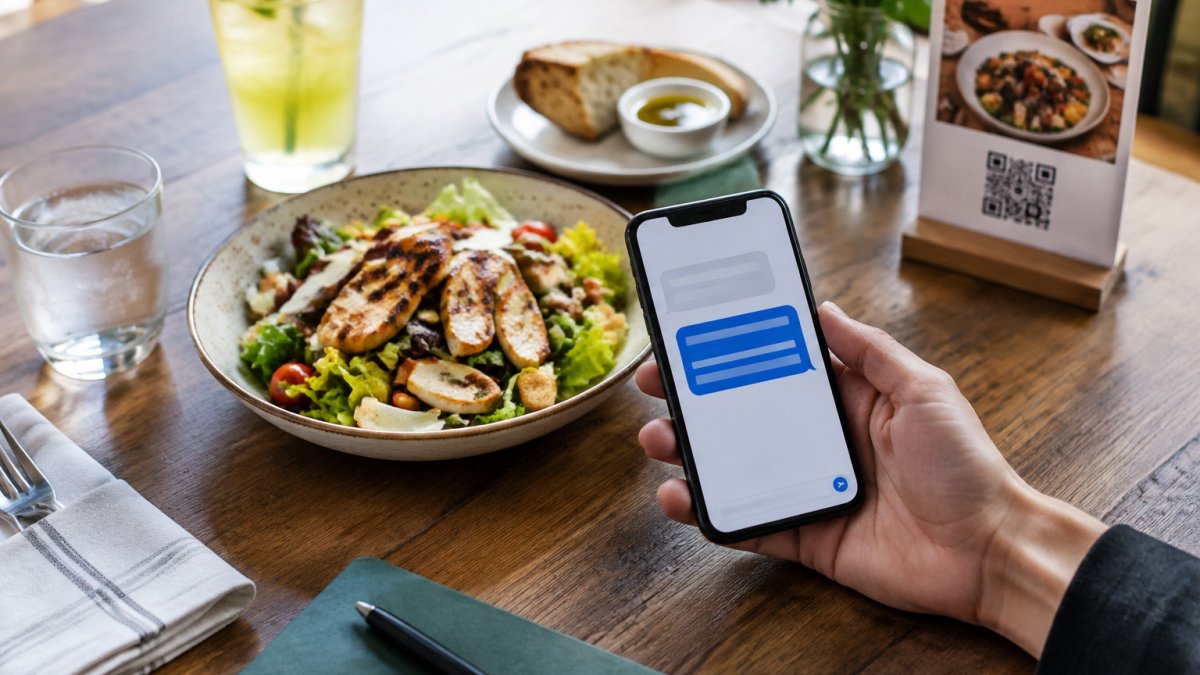
The most profitable text a restaurant sends goes out 24 to 48 hours after a visit. A short thank-you with a reason to return converts a single meal into a habit.
Timing matters more than copy: too soon feels automated, a week later the memory has faded.
- Day 1: "Thanks for joining us last night, [Name]. Your server said the [dish] was a hit."
- Day 3: "That [dish] is back on the menu this weekend. Show this text for a free dessert."
- Day 14: "We saved your usual table. Come back this week and your first appetizer is on us."
The mistake most operators make is blasting the same follow-up to everyone. Segment by what they ordered or which night they came in, and response rates climb.
2. Loyalty Program Activation and Member-Only Offers
Loyalty texts work when they feel like a reward, not a coupon. A member-only offer should tell subscribers they get something the general public cannot.
The structure that performs best: announce the perk, name the limit, set a deadline.
- "Members only: half-price wings every Tuesday this month. Just show your membership."
- "You're 2 visits from a free entrée. One more dinner and it's yours."
- "Early access: our fall menu drops Thursday. Members taste it Wednesday."
The Regulars Club makes this simple. If you are building the program behind those texts, our restaurant rewards program guide covers the structure.
3. Time-Sensitive Promotions and Slow-Night Fillers
Tuesday at 6 p.m. is a ghost town for plenty of restaurants. A text sent Monday afternoon can fill it.
Short windows beat long ones. Industry benchmarks put SMS click-through rates between 19% and 36% according to MessageFlow's 2026 SMS marketing benchmarks, and urgency is the lever that pushes you toward the top of that range.
- "Rainy day special: half-price apps until 8 tonight."
- "Slow night, big deal. Two-for-one entrées tonight only."
- "Kitchen's experimenting. First 20 texts get a free taste at 5 p.m."
Pair each promotion with an engagement tactic from our restaurant guest engagement strategies so the discount builds a relationship instead of training diners to wait for markdowns.
4. New Menu Item Announcements and Seasonal Launches
A new menu item deserves a text, but only if you give subscribers a reason to care beyond "it's new." Lead with the flavor, the story, or the scarcity.
- "The short rib is back. Braised 12 hours, gone by 9. Reserve your plate."
- "Peach season is here. Our cobbler is on the menu starting Friday."
- "Chef's new burger drops Monday. First 50 texts get it half off."
Seasonal launches work best when the text arrives the day before, not the day of. Diners plan their week, and a heads-up beats a same-day scramble.
5. Customer Reactivation: Winning Back Lapsed Regulars
A diner who has not visited in 60 days is not gone. They forgot. A reactivation text reminds them why they came in.
The best reactivation messages reference something specific. "We miss you" is weak. "Your usual booth is still here" is a memory.
- "It's been a while, [Name]. Your favorite [dish] is still on the menu, and we saved you a seat."
- "We noticed you haven't been in since summer. Come back this week and dessert is on us."
- "Two months is too long. Here's 20% off your next visit, just for you."
Reactivation only works as part of a bigger retention plan. Our guide to restaurant customer retention strategies covers the seven approaches that keep regulars from lapsing.
Restaurant SMS Campaign Templates You Can Copy Today
Here are ready-to-send templates for the campaigns above.
Post-visit follow-up
Hi [Name], thanks for dining at [Restaurant] last night.
Loyalty activation
[Name], you're one visit from a free entrée.
Slow-night filler
Tonight only at [Restaurant]: [offer] until [time]. Show this text to redeem.
New menu launch
The [dish] is back at [Restaurant] starting [date]. First [number] guests get [offer].
Reactivation
We miss you, [Name].
The Fields That Do the Work
A template is only as good as the data behind it. Each bracketed field has a rule:
- [Name], use the first name from the loyalty sign-up, not the name on the card. "Hi Mike" beats "Hi Valued Guest," and a misspelled name is worse than no name.
- [item], pull from the diner's last order where the POS allows it. "Your short rib" converts; "a free item" does not.
- [date] and [time], always include both. "Before Friday" is a deadline; "soon" is not.
Opt-In and Opt-Out Language That Holds Up
Every template ends with an opt-out line. The FCC's rules on robocalls and texts require clear consent and an easy way to stop messages, and the TCPA carries real penalties for restaurants that skip it.
The opt-in side is where most operators get caught. A compliant sign-up at the table reads: "By providing your number, you agree to receive marketing texts from [Restaurant]. Message frequency varies.
Watch out: a template that says "Reply STOP to opt out" but routes STOP replies to a shared inbox nobody monitors is a compliance failure in practice.
Adapting Templates Without Breaking Them
The five templates above cover the campaigns in this article, but the same structure works for any send: a specific reason to act, a concrete offer, a deadline, and the opt-out line. Keep that order, reversing it is the most common reason a copied template underperforms.
When you are ready to run these campaigns with a platform that sends the texts and tracks the results, The Regulars Club membership platform connects your offers to diners who already eat local.
Restaurant SMS Marketing Best Practices: Frequency, Timing, and Segmentation
Restaurant SMS marketing best practices come down to three levers: how often you send, when you send, and who gets which message. Get those right, then layer on compliance, testing, and integration.
Frequency. Two to four texts a month is a reasonable starting point for most restaurants. More messages can increase opt-outs; fewer can cause subscribers to forget you. Anchor one send to a recurring promotion (Taco Tuesday, half-price wine Wednesday) and treat the rest as one-offs, so subscribers learn when to expect you.
Timing. Consider sending lunch pushes midday and dinner promotions in the afternoon, and avoid late-evening sends. Plan slow-night offers with the diner's week in mind.
Segmentation. Split your list by visit frequency, favorite dishes, and neighborhood. A weekly regular gets different messages than a twice-a-year visitor.
| Best Practice | What to Do | Why It Matters |
|---|---|---|
| Frequency | 2-4 texts per month | Higher volume drives opt-outs |
| Timing | 10 a.m.-2 p.m. or 3 p.m.-5 p.m. | Matches meal planning windows |
| Segmentation | Split by visits, dishes, location | Personalization lifts response |
| Compliance | Written opt-in plus STOP handling | TCPA and FCC exposure |
| Testing | One variable per test, 500+ per cell | Clean read on what moved visits |
Compliance: What TCPA and FCC Rules Actually Require
Marketing texts are subject to the Telephone Consumer Protection Act and related FCC rules. The practical requirements for a restaurant are narrower than the fear around them, but they are not optional:
- Written consent before the first marketing text. Collect it at the table on a sign-up card, on the receipt, or through a sign-up offer. Keep the record, the date, the number, and how consent was given. The FTC's guidance on text message marketing is clear that consent must be provable, and a screenshot of a paper sign-up sheet is not a record.
- Clear and conspicuous disclosure. The opt-in must state that the diner agrees to receive marketing texts, that message frequency varies, that message and data rates may apply, and that they can reply STOP to opt out.
- Honor STOP immediately. Every template in this article ends with an opt-out line for a reason. A STOP reply must suppress the number across all campaigns, not just the one that triggered it.
Watch out: consent collected by a third party, a delivery app, a giveaway site, a lead-gen list, does not transfer to your restaurant. Consent collected by a third party does not transfer to your restaurant, so purchased lists carry compliance risk.
A/B Testing: A Framework You Can Run in a Week
Testing is where most restaurants stop at "we tried two subject lines." A workable framework:
- Pick one variable. The offer, the send time, or the wording, never two at once, or you cannot tell which one moved the number.
- Split evenly and size the cells. Send 500 texts to each segment where your list allows it; below roughly 200 per cell, the difference is usually noise.
- Define the win before you send. Clicks are a proxy. The number that matters is redemptions at the POS.
- Run it once, then again. Two tests on the same variable tell you whether it is a pattern.
A campaign that sends 500 texts to two segments tells you which offer wins within a week, but only if you are reading redemptions, not opens.
POS Integration: Closing the Loop Between Send and Sale
Tie your text platform to your POS so you can see which messages drove actual visits, not just clicks. The SMS platform writes a unique offer code or coupon button into the POS, the diner redeems it at the register, and the POS reports the redemption against the send.
The practical question to ask any SMS vendor is whether a redemption in the POS can be attributed to a specific text send. If not, the testing framework above cannot run.
Negative Feedback: Route Complaints Before They Become Reviews
Give diners a way to reply with a complaint, and route those replies to a manager. A text that says "the pasta was cold" is a chance to fix it before a review goes public. Replies must land somewhere a human reads them within a day, a common pattern is to have the manager on duty own reply duty for the shift, with a one-line log of what was fixed.
Frequently Asked Questions
What makes a restaurant SMS campaign effective?
An effective restaurant SMS marketing campaign combines a clear call to action with a specific, time-bound reason to visit. Messages that mention a dish by name, a deadline, or a member-only perk get higher click-through rates than generic blasts. Keep messages under 160 characters, include your restaurant name, and always offer an easy opt-out. SMS is generally read and responded to more quickly than email, so the channel rewards tight, purposeful copy.
How often should a restaurant send marketing text messages?
Two to four messages per month is a safe starting point for most independent restaurants. Send more only when you have something genuinely worth saying, like a new menu launch or a limited-time offer. Track unsubscribe rates after each send; a spike means you are sending too often or without enough value. Segmenting your list so diners only get messages relevant to them keeps message frequency from feeling like spam.
How can restaurants encourage customers to sign up for text messages?
Offer an immediate incentive at the point of sign-up. A table tent or receipt insert that promises a free appetizer or a first-visit discount in exchange for joining your SMS list converts far better than a plain ask. Train servers to mention the program at checkout, and include a QR code on menus that opens a short opt-in form. Make the SMS marketing sign up process take under 30 seconds and confirm enrollment with a welcome text that states what subscribers will receive.
What should a restaurant include in a promotional text message?
Every promotional text needs four elements: your restaurant name, the specific offer, the deadline, and a trackable link or clear instruction. For example: "Luigi's: Free garlic knots with any entree through Sunday. Show this text at the counter. Reply STOP to opt out." Avoid stacking multiple offers in one message. Personalization helps too. Referencing a diner's last order or favorite dish raises conversion rates and makes the message feel like it came from a regular's neighborhood spot, not a bulk sender.
What are the TCPA rules restaurants must follow for SMS marketing?
The Telephone Consumer Protection Act requires prior express written consent before you send marketing texts, and that consent must be documented. Every message needs a clear opt-out mechanism, and you must honor opt-outs immediately. Sending promotional texts without consent can carry significant legal penalties. Work with an SMS platform that captures consent timestamps and maintains an audit trail. Compliance is not optional, and it protects both your customers and your business.
Texting your regulars is not a technology problem. It is a habit problem. Most independent restaurants have the phone numbers and the offers; they just never build the rhythm that turns a one-time diner into a weekly guest. The Regulars Club gives restaurants a membership platform that sends the texts, tracks the visits, and rewards the regulars, all without replacing the POS you already run. Get started with The Regulars Club and turn your text list into a steady stream of repeat visits.